AI Agent Orchestration Platform
Define agents in YAML. Discover peers via capability cards. Compose teams. Stream responses. Ship a single binary. AgentGo brings compiled-language performance and typed multi-agent collaboration to agentic AI.
Private repository — contact us for access
Why AgentGo?
Purpose-built to solve the real pain points of running AI agents in production
The Problem
Heavy Python Runtimes
Multi-GB Docker images, slow cold starts, GIL-limited concurrency. Every agent deployment becomes an infrastructure burden.
Poor Concurrency Models
Thread pools and async/await don't scale. Running 100+ concurrent agents means fighting your runtime, not building features.
No Built-in Observability
Bolting on monitoring after the fact. Custom metrics, tracing, and audit logging are afterthoughts in most frameworks.
Configuration Sprawl
Agent definitions scattered across code, environment variables, and deployment configs. No single source of truth.
The AgentGo Solution
Compiled Go Binary
~30MB statically-linked binary. Sub-second cold starts. No interpreter, no virtual environment, no dependency hell.
Goroutine Worker Pool
Native goroutine-based scheduler handles thousands of concurrent agents. Zero contention, built-in backpressure, graceful shutdown.
130+ Prometheus Metrics
Instrumented from day one. Pre-built Grafana dashboards, JSONL audit logs, structured logging, and cost tracking out of the box.
Single YAML Per Agent
One file defines the agent: model, tools, prompts, permissions, guardrails. Hot-reload on change. Pack system for distribution.
Platform Features
Everything you need to build, deploy, and operate AI agents at scale
Multi-LLM Providers
Gemini, OpenAI, Anthropic, and LiteLLM proxy. Switch providers per-agent via config. Streaming and function calling across all backends.
Flexible Agents
YAML-defined agents with prompt templates, tool bindings, and schema validation. Pack system for reusable agent bundles. Subagent delegation.
Workflow Engine
Sequential, parallel, and conditional execution. Dynamic supervisor pattern with event-driven orchestration. Visual diagram generation.
Durable Agents
Persistent, event-driven agent instances with SQLite checkpoints. Crash recovery, pause/resume, mailbox messaging, and approval workflows.
Chat & Streaming
Multi-turn chat sessions with SSE token streaming, idle watchdog, and parallel non-blocking tool dispatch. Interactive CLI REPL plus a React + TypeScript Web Console (chat, workflows, durable agents, schedules, mermaid diagrams).
Tool Ecosystem
Native Go tools, YAML-configured tools, shell scripts, MCP server integration, and connector-backed integrations (T1/T2/T3 authoring tiers). Skill-provided tools with schema validation and timeouts.
Scheduling & Triggers
Cron scheduling with SQLite persistence. Webhook triggers with HMAC validation. Timer-based and poll-based event sources for durable agents.
Observability
130+ Prometheus metrics with pre-built Grafana dashboards. Structured JSON logging via Loki, JSONL audit trails per tool call, and a W3C-conformant cross-agent span tree (/v1/traces/{id}) with cost roll-up to the root caller.
Security & Guardrails
API key authentication, filesystem and network permission sandboxing. Cost guardrails with per-agent budgets. Rate limiting and circuit breakers.
Skills System
Self-contained knowledge packages with trigger-based discovery. Skills bundle instructions, tools, and dependencies with SemVer compatibility. Supports remote MCP/HTTP sources and inter-skill dependencies.
Multi-Agent Collaboration
Capability cards expose typed intents, JSON-Schema I/O, and ACL matchers. Peers discover each other via discover_agents/route_intent and call call_agent with W3C trace propagation, idempotency, per-target/per-caller token-bucket quotas, and end-to-end cost roll-up. Declarative teams compose planner-workers and pipeline protocols (contract-net + swarm flag-gated); subagents and 3-hop handoff remain for in-session coordination.
Integrations & Connectors
Config-driven outbound integrations. Pluggable secret backends (env, file, Vault, AWS-SM, GCP-SM), hot-reload, boot-time scope enforcement, and per-principal impersonation. Built-ins: GitHub, Postgres, generic REST. Codegen from OpenAPI.
Native DB Tools
First-class database access without LLM overhead. Schema-validated CRUD, raw parameterized SQL, and audit. Per-table access policies with grammar-validated row-filter expressions (32 SQL injection vectors rejected). SQLite + Postgres dialects.
Memory & Context
Per-agent persistent memory with four typed scopes (user, feedback, project, reference) and MEMORY.md indexing. Automatic stale-output pruning, LRU tmp file eviction, and pre-compaction LLM extraction so long sessions stay coherent.
Channel Adapters
Slack (HMAC-SHA256, Block Kit) and Discord (Ed25519, deferred ack) out of the box. ChannelRouter with per-instance busy flag eliminates head-of-line blocking; exponential-backoff retry with crash recovery and dead-letter inspection.
Architecture
A modular, layered architecture designed for extensibility and production reliability
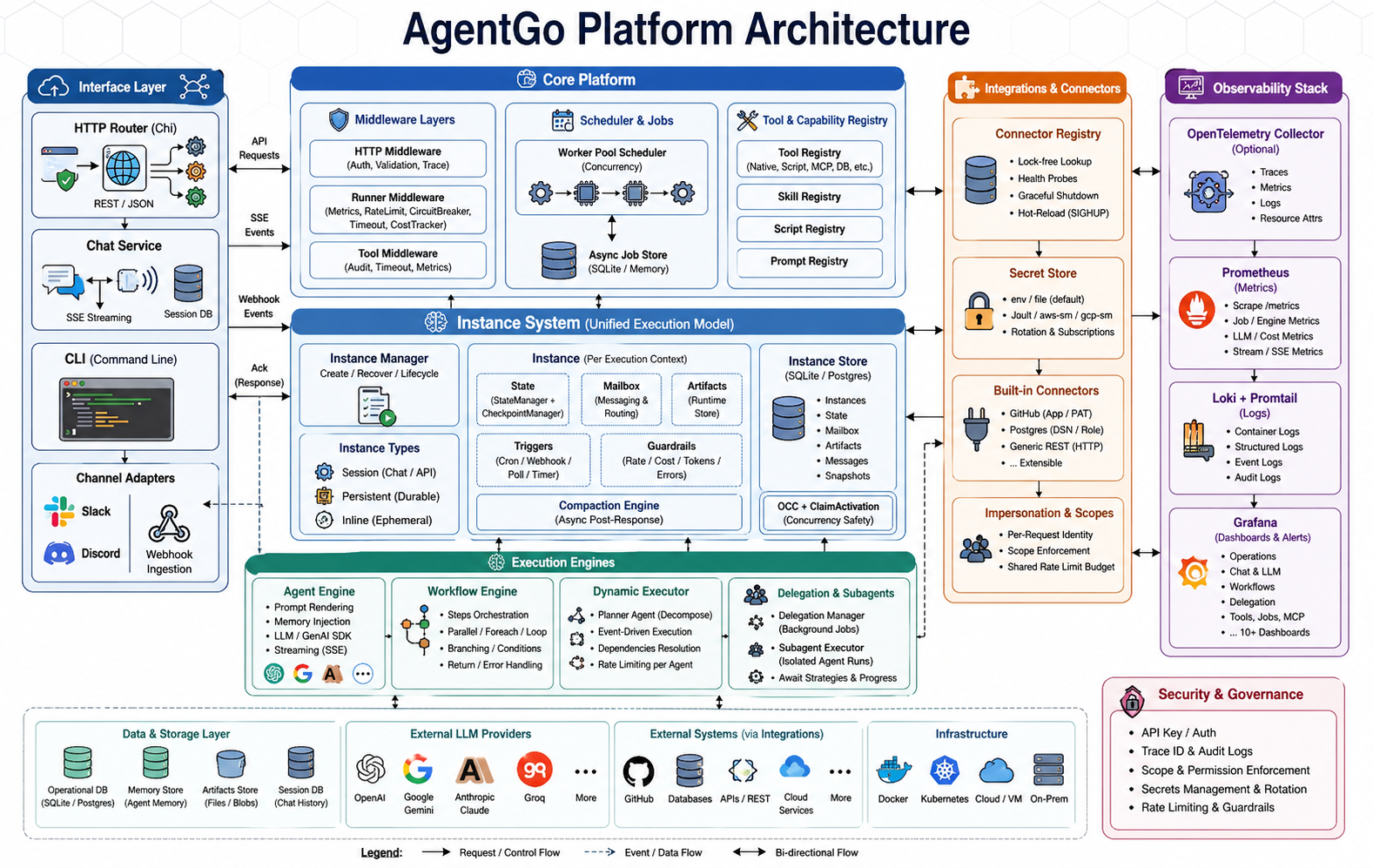
Request → Router → Handler → Scheduler → Agent → GenAI
                   ↓           ↓
             WorkflowEngine  ToolRegistry
                   ↓               ↓
             ChatService    DelegationManager
                   ↓               ↓
             SSE Streaming  CronScheduler
                                      ↓
                                DurableManager → Instance(s) → Orchestrator
Define Agents in YAML
No boilerplate code. One file defines your agent's model, behavior, tools, and constraints.
name: researcher
description: Deep research agent with web access
model: gemini-3-flash-preview
provider: gemini

prompt_template: research.tmpl
system_prompt: |
  You are a thorough research assistant.
  Always cite sources and verify claims.

tools:
  - web_search
  - read_file
  - write_file

parameters:
  temperature: 0.3
  max_tokens: 8192
  max_iterations: 15

permissions:
  filesystem:
    allowed_dirs: ["/data/research"]
  network:
    allowed_domains: ["*.google.com"]
id: Jarvis
name: Jarvis Agent
version: "2.0.0"
model: gemini-3.1-pro-preview
tools: [save_memory, read_memory, delegate, subagent, ...]

memory:
  enabled: true
  scopes: [global, self]
  inject_mode: index_only

durable:
  enabled: true
  auto_start: true
  objective: |
    Persistent personal AI assistant —
    briefings, tasks, and inbox handling.
  activation_timeout: 10m
  cooldown: 5s
  max_activations_per_hour: 120
  max_tokens_per_activation: 50000
  triggers:
    - type: cron
      expr: "0 8 * * 1-5"
      input: '{"reason": "morning_briefing"}'
  state:
    initial:
      tasks: []
      notes: {}
    eviction:
      tasks: { max_items: 200 }
      notes: { max_items: 100 }
  mailbox:
    severity_routing:
      critical: ["outbox"]
      warning: ["outbox"]
  permissions:
    fs: ["read:configs/", "write:data/sessions/"]
    create: [skill, agent, workflow]
    approval_mode: review
name: research-pipeline
description: Multi-step research with review
steps:
  - name: gather
    agent: researcher
    input: "Research: {{.query}}"
  - name: analyze
    agent: analyst
    input: "{{.steps.gather.output}}"
    depends_on: [gather]
  - name: review
    parallel:
      - agent: fact-checker
        input: "{{.steps.analyze.output}}"
      - agent: editor
        input: "{{.steps.analyze.output}}"
  - name: publish
    agent: writer
    input: "{{.steps.review.outputs}}"
    condition: "{{.steps.review.all_passed}}"
Declarative Configuration
Every agent aspect is defined in YAML: model selection, prompt templates, tool bindings, iteration limits, and safety permissions. No Go code required to create new agents.
Hot Reload
Edit YAML, send SIGHUP. Agent configs reload without restarting the server. Zero-downtime updates to prompts, tools, and parameters.
Pack System
Bundle agents with their prompts, tools, and skills into distributable packs. Import community packs or create your own via manifest.yaml.
Built-in Guardrails
Filesystem sandboxing, network restrictions, cost budgets, and iteration limits are first-class config. Security is declarative, not an afterthought.
AI-Powered Configuration
Describe what you need in plain English. The Config Manager agent builds production-ready configs through conversation.
$ agentgo chat start config-manager
Session started · config-manager · gemini-3.1-pro-preview
You:
Create a sentiment analysis agent that monitors
Twitter mentions and alerts on negative trends
Config Manager:
I'll create a complete stack for that:
1. Agent sentiment-monitor with twitter-search,
sentiment-analyze, and slack-notify tools
2. Workflow sentiment-pipeline with
fetch → analyze → alert steps
3. Cron trigger every 15 minutes
4. Cost budget $5/day
Shall I proceed? [approve] [edit] [cancel]
You: approve
✓ Created agent sentiment-monitor
✓ Created workflow sentiment-pipeline
✓ Validated all configs
✓ Hot-reloaded — agent is live
Conversational Setup
Describe your business needs in plain English. The Config Manager translates requirements into valid YAML — agents, workflows, tools, and prompts.
Safe Deployment
Automatic validation, backup, and hot-reload with health checks. Approval gates for sensitive operations ensure nothing goes live without your sign-off.
Full Stack Generation
Creates agents, workflows, tools, and prompts in one session. Pack-aware bundling groups related configs for portable deployment.
Audit Trail
Every change is validated, backed up, and logged. Rollback information preserved so you can undo any configuration change.
LLM Providers
First-class support for major LLM providers with a unified interface
Token Streaming
Real-time SSE streaming across all providers. Consistent callback interface regardless of backend.
Function Calling
Unified tool/function schema. Provider-specific adaptors handle format differences transparently.
Provider Failover
RetryLLMCall with exponential backoff. Switch providers per-agent without code changes.
Performance & Deployment
Compiled for speed, packaged for simplicity
Docker
Minimal Alpine-based image. Single container, production-ready.
Compose Stack
Modular: AgentGo + Postgres + Prometheus + Grafana + Loki. Independent up/down per layer.
Single Binary
Download and run. Embedded configs and resources. No install step.
Hot Reload
SIGHUP reloads agent and workflow configs. Zero-downtime updates.
Get Started
From zero to running agents in three steps
Clone & Build
# Request access first
git clone <repo-url>
make build
Configure
export GEMINI_API_KEY=your-key
# Edit configs/agents/*.yaml
Run
./agentgo serve
# Or: make docker-run
Private repository — contact us for access